How Do I Find Mold in a Scottsdale House That Sat Closed All Summer?
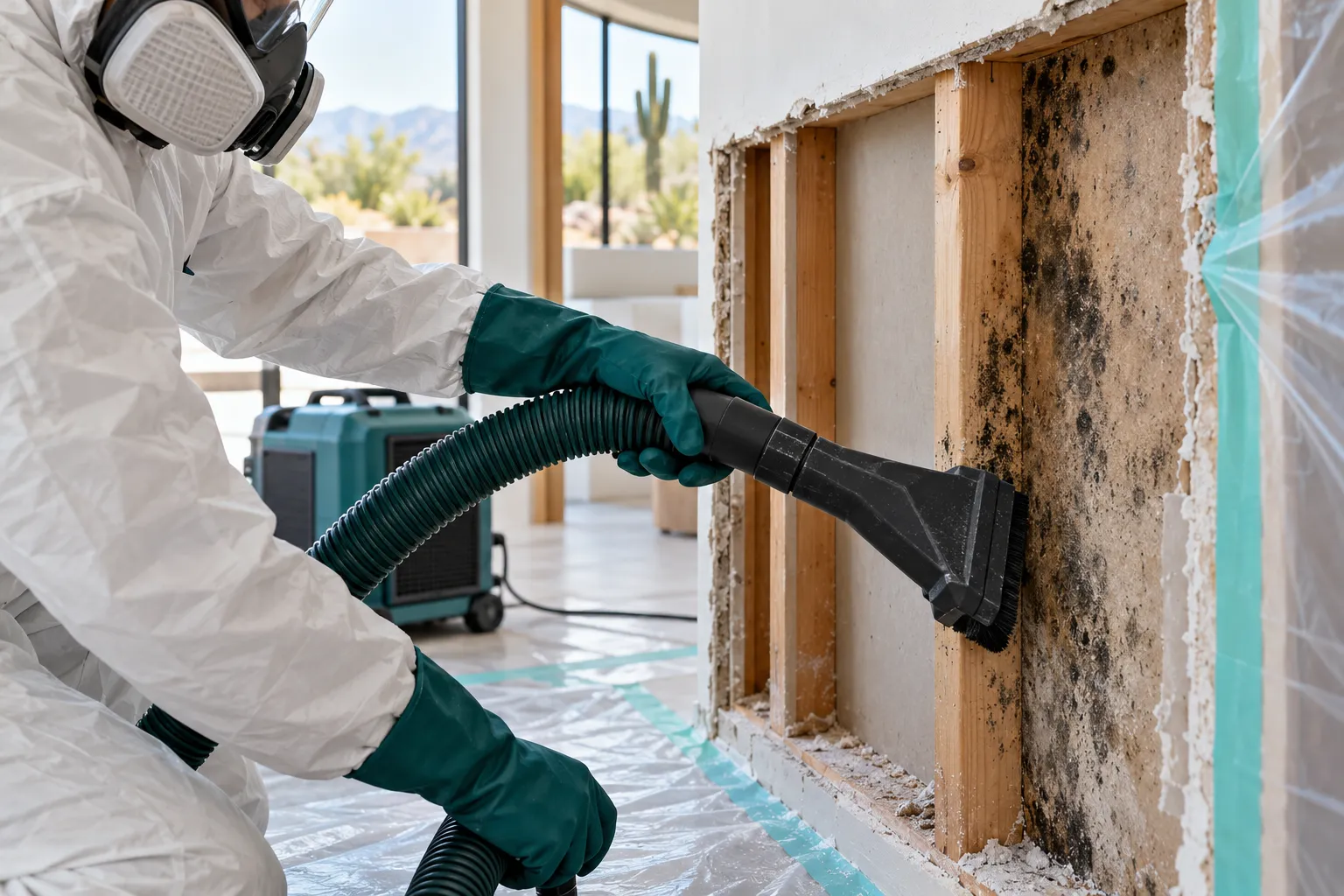
You open the front door in October and the smell hits you before your eyes adjust. Not dust, not the heat. Musty, earthy, the smell of something that grew while nobody was there. Then you start noticing: a brown ring on the hallway ceiling, a dark bloom along a baseboard, gray fuzz in a shower corner that was clean in May. The house sat closed for five months, and something in it had water the whole time. This is the most common mold story in Scottsdale, and it has a structure. Here is what actually happened, where to look, and what to do about it before the next summer starts.
Published
Get a call back
Fill in the form or call (480) 844-3647. Calls are answered day and night.
§ 01 / 06
Why a closed-up house grows mold in the desert
A closed Scottsdale house is a still-air box for five months. The AC is off or running in setback, so nothing moves the air. The attic bakes, the interior heats, and any moisture that appears has nowhere to go. The same house that never felt humid while you lived in it becomes a sealed container the moment you leave, and containers hold water.
Desert houses do not grow mold from desert humidity. An Arizona house grows mold from a water source, and the mold section of the playbook is always the same: a single slow supply-line leak can support a colony for an entire season. Outside humidity never mattered. A drip that would have been noticed in a day goes unnoticed for twenty weeks, and twenty weeks of drip is how a colony gets established inside a wall cavity instead of on the paint.
The smell is the giveaway that the house has been closed. Air that has not moved for months concentrates the odor of whatever grew, so the same problem that might be faint in an occupied house announces itself the moment the door opens. Trust it. The smell knows more than your eyes do at first glance.
§ 02 / 06
The three water sources that do it here
Scottsdale's closed-house mold almost always traces to one of three places, and each one behaves differently.
The first is the AC condensate line. Lines run through ceilings, and when a line clogs or a joint seeps, the water drips onto the back side of the drywall above your head. Nothing is visible from below until the stain comes through. That can take weeks, and by then the cavity above the ceiling has been wet the whole time. If your house has lines in the ceiling, this is the first suspect, not the last. The AC and duct mold page explains how these failures run.
The second is the monsoon roof leak. July through September is when it happens: water arrives faster than a flat roof and its parapets can shed it, ponds against the parapet, and finds a seam. The entry is rarely above the stain. Water runs along the deck and shows up a room away. In a closed house, nobody sees the drip, nobody moves a bucket, and the ceiling cavity stays wet through the whole storm season.
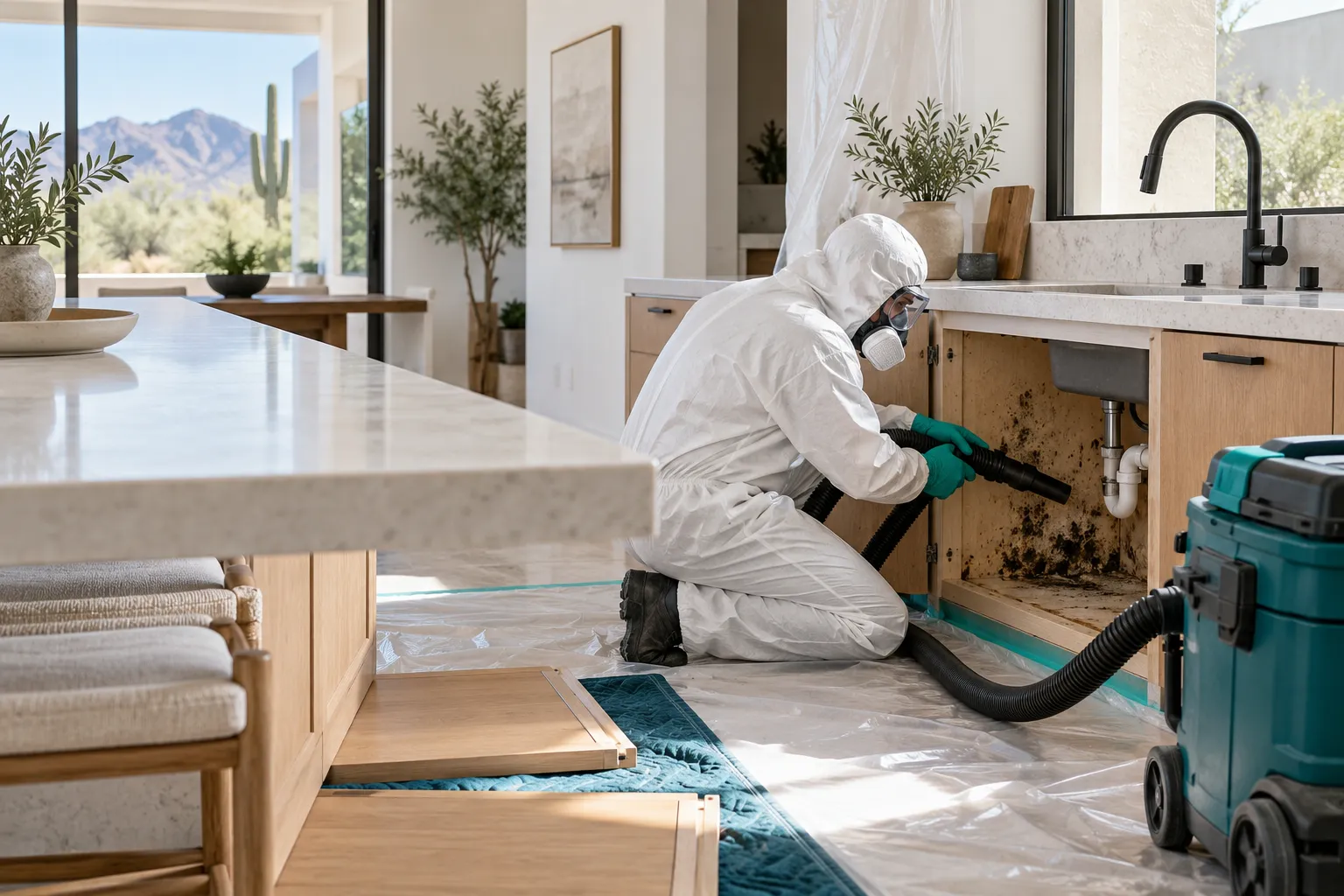
The third is the slow plumbing leak nobody was home to catch. A supply line at a vanity, a toilet seal, a water heater connection. These leak in teaspoons, and teaspoons are enough. The mold needs water that stays, and a slow leak is water that stays.
§ 03 / 06
What to check when you open the house
Walk it in order, and use your nose as much as your eyes.
Turn the AC on first, and listen. A line that drips into a ceiling makes a sound you will catch in a quiet house. Then check the drip pan under the air handler and the condensate line where you can see it. Water stains follow water, so look up: every ceiling, especially the ones below bathrooms and below any line run.
Under every sink, at every shutoff. Around the water heater. Toilet bases and the ceiling below every bathroom. Window sills and tracks, where monsoon condensation collected. Tile grout and caulk in the showers. Baseboards on exterior walls, where a slab-level leak shows first.
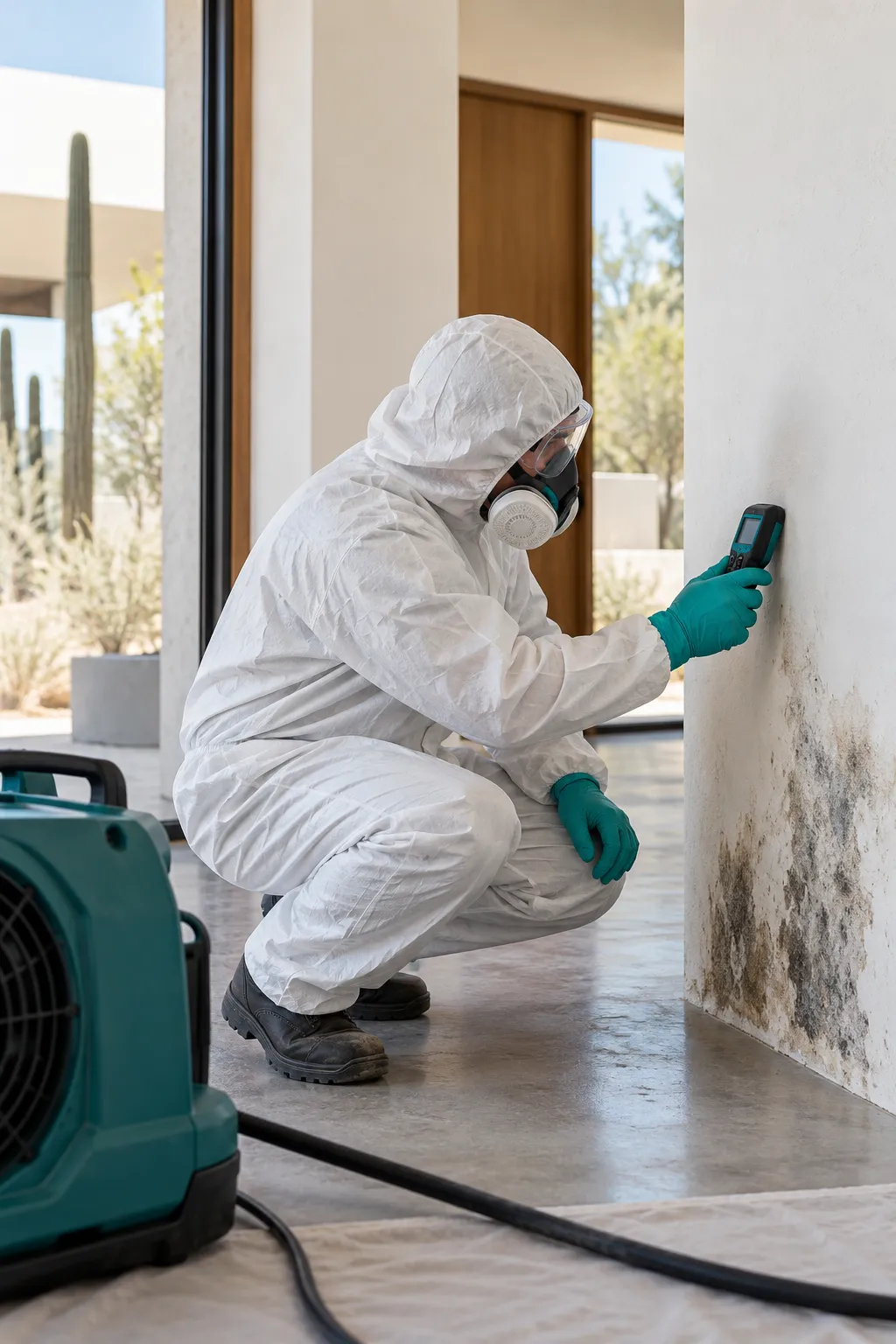
Then the attic, if you can access it safely. A flashlight over the water heater, over the air handler, along the underside of the roof deck. A dark stain on framing or decking is the map of where the water came in. If you are not comfortable in the attic, that is a normal thing to be, and it is exactly what an inspection is for. The mold inspection and testing page covers what that visit looks like.
§ 04 / 06
How to tell a stain from a colony
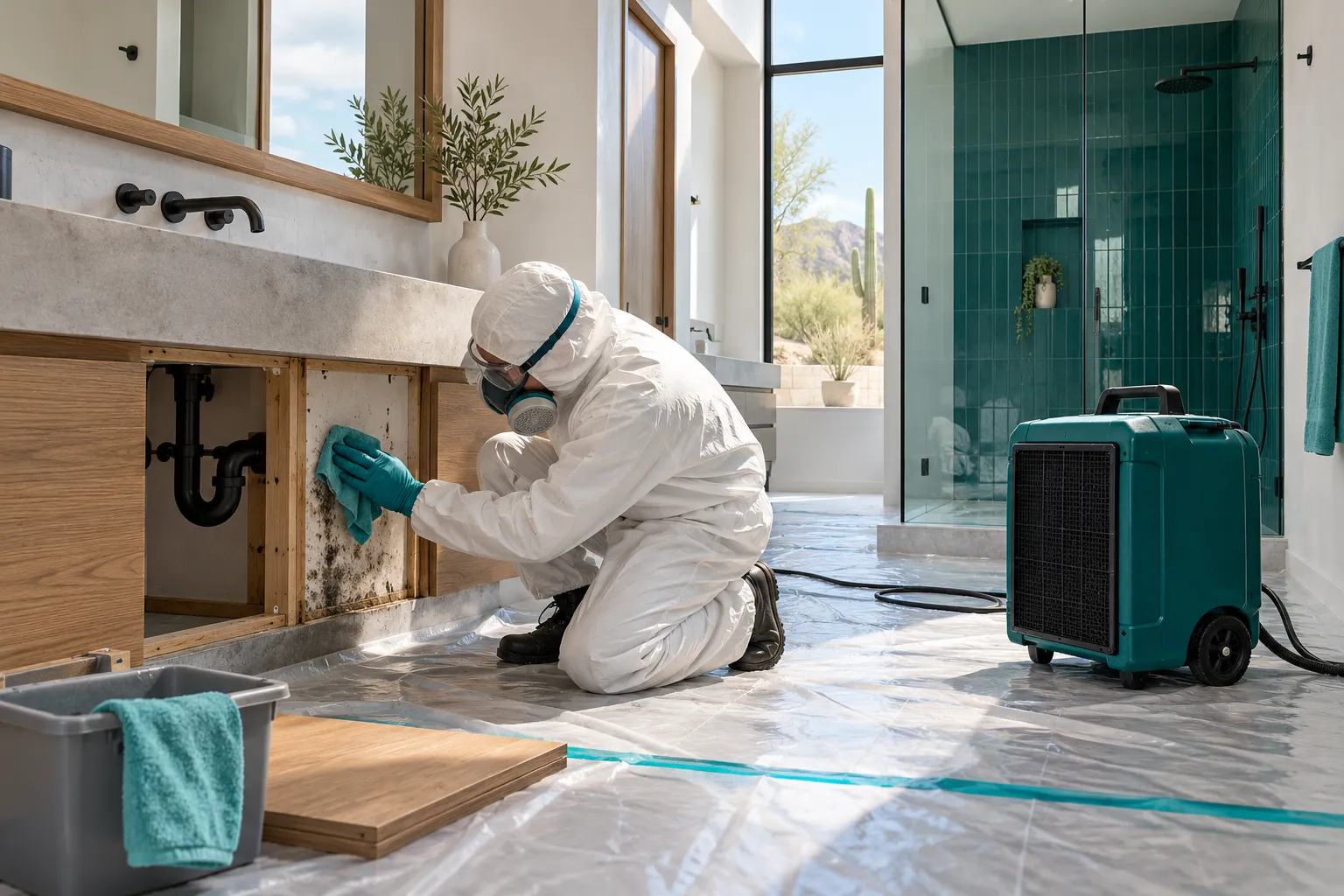
Not every brown ring is mold, and not every mold patch is active. The quick reads: a stain from a long-gone leak is usually uniform and dry, while a colony has texture, fuzzy edges, or a bloom pattern that spreads in rings. A musty smell that sharpens when you stand under it is a live signal. And the material behind the patch tells you the rest: if the drywall is soft, spongy, or crumbling at the stain, the water ran long enough to break the gypsum down, and that is a colony with history.
Efflorescence confuses people here too, a white mineral crust from water moving through masonry that looks like mold and is not. A drop of water dissolves it; mold smears. The mold vs efflorescence page covers the difference in a minute.
The one thing not to do: wipe the patch, spray it, and close the house again for winter. If the water source is still live, you have removed the evidence and left the problem running. The removal vs remediation page explains why a wipe is not a fix.
Line open now
Mold growing right now?
Describe what you see or smell. You do not need to diagnose anything yourself.
§ 05 / 06
What to do when you find it
Name the water first. The mold is downstream of the water, and everything about the job, the scope, the price, depends on where the water came from and whether it is stopped. A condensate line is a different repair than a parapet leak, and both are different from a supply line.
Then get the scope in writing. Real remediation quotes name the source, include containment so demolition does not spread spores through the rest of the closed house, dry the cavity to a measured standard, and end with a clearance check. A quote that cannot name the water source is not a quote, it is a guess with a number on it. The quote walkthrough goes line by line through what belongs in one.
And check the calendar. If it is October, you have roughly seven months before the next monsoon season starts, which is a comfortable window for a proper job and a tight one for ignoring the problem.
§ 06 / 066 questions
How Do I Find Mold in a Scottsdale House That Sat Closed All Summer?: your questions
01Why did my house grow mold while I was gone?
Because water was present while nobody was there to notice. A slow leak or a monsoon entry point fed the colony all summer, and the closed house held the moisture in place.
02Does turning the AC off cause mold?
The AC off is not the cause, but it is the amplifier. No air movement means any moisture from a leak stays put, and the colony grows undisturbed. The water is the cause.
03What should I do the first time I open the house?
Turn on the AC and listen, walk every room with your nose, check under sinks and around the water heater, and look up at every ceiling. The mold inspection and testing page has the full list.
04Is the musty smell a reliable sign of mold?
It is the most reliable sign there is. A closed house concentrates it. If the smell is present but nothing is visible, the growth is probably inside a cavity, and an inspection finds it.
05Can I just clean the stains and move back in?
Only if the water is stopped and the patch is surface film on a hard material. A stain on drywall with an active source above it comes back, and the colony behind it keeps releasing spores.
06How fast does mold grow in a closed house?
Fast enough that a summer is plenty. A drip that starts in June has months of warm, still air to establish a colony inside a wall cavity before anyone sees the stain.