How Do I Read a Mold Remediation Quote in Scottsdale, AZ?
Two quotes for the same hallway ceiling. One is half the price of the other, and neither one tells you what the money buys. One says containment, drying, and clearance. The other says treatment and paint. Both call it mold remediation, and now you are standing in the hallway trying to compare two documents that are not describing the same job. This is the most common complaint in the Scottsdale mold trade: quotes that swing wildly for the same room, with no way to tell what is being priced. Here is how to read one line by line, so the cheaper quote does not quietly become the expensive one.
Published
Get a call back
Fill in the form or call (480) 844-3647. Calls are answered day and night.
§ 01 / 06
Why the numbers swing
Mold remediation quotes swing because scope swings, and scope swings because nothing in the trade has a fixed definition. One company prices the full job: find the water, stop it, contain the area, remove the colonized material, dry the cavity, and verify the air with a clearance test. Another prices the last two steps of that list, a wipe-down and a coat of paint, and calls it the same service.
The difference is not greed, mostly. It is what each bidder is willing to name in writing. The full-scope quote looks expensive because it is honest about the work. The wipe-and-paint quote looks cheap because it leaves out everything that actually fixes the problem. Six months later, the stain is back, the cheap job is now the expensive job plus a second one, and the homeowner pays twice.
Your job as the reader is not to compare totals. It is to compare line items, and the pricing page shows how a real scope stacks up.
§ 02 / 06
The line items a real quote names
A real remediation quote reads like a sequence, because remediation is a sequence. Each line should be there, in order.
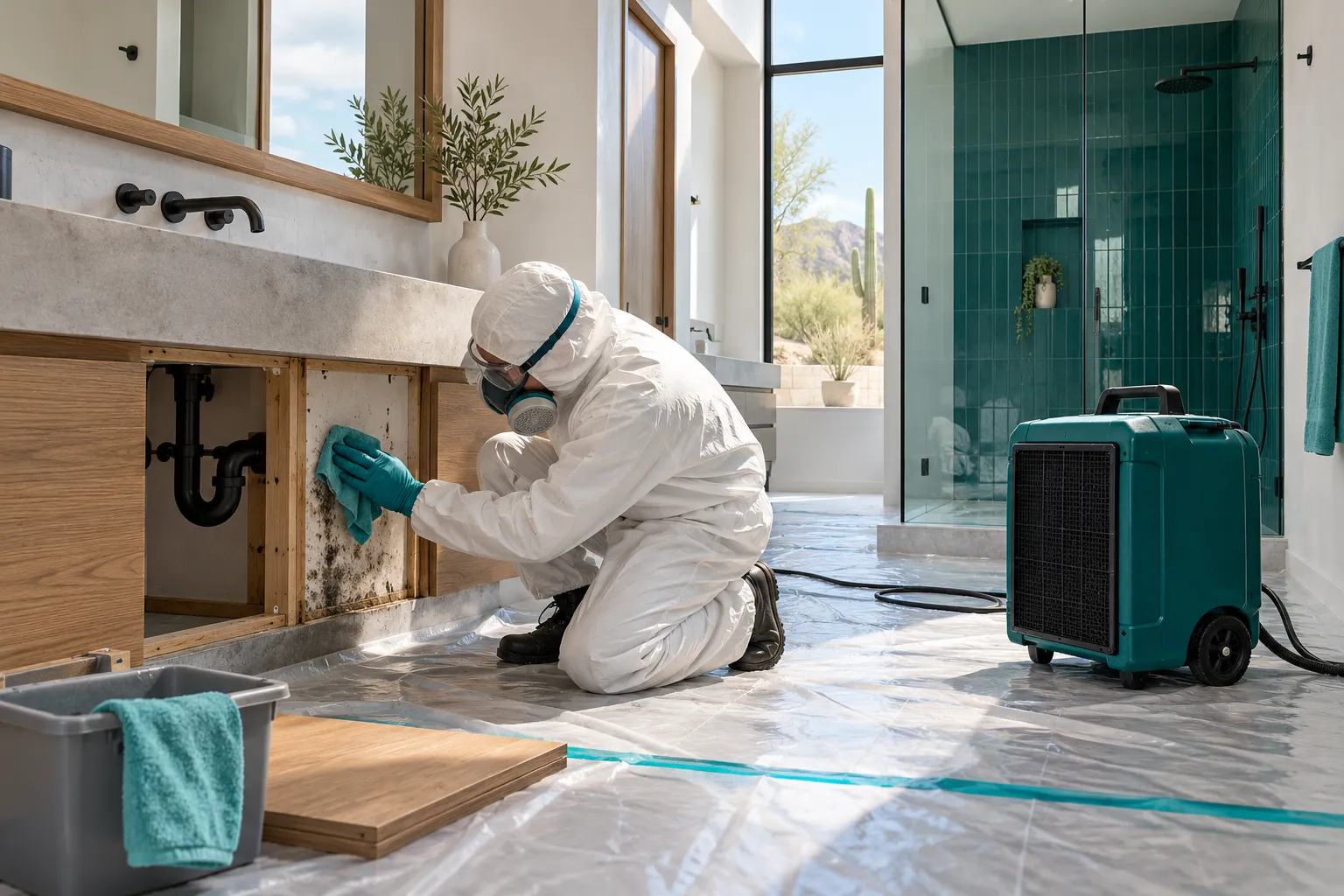
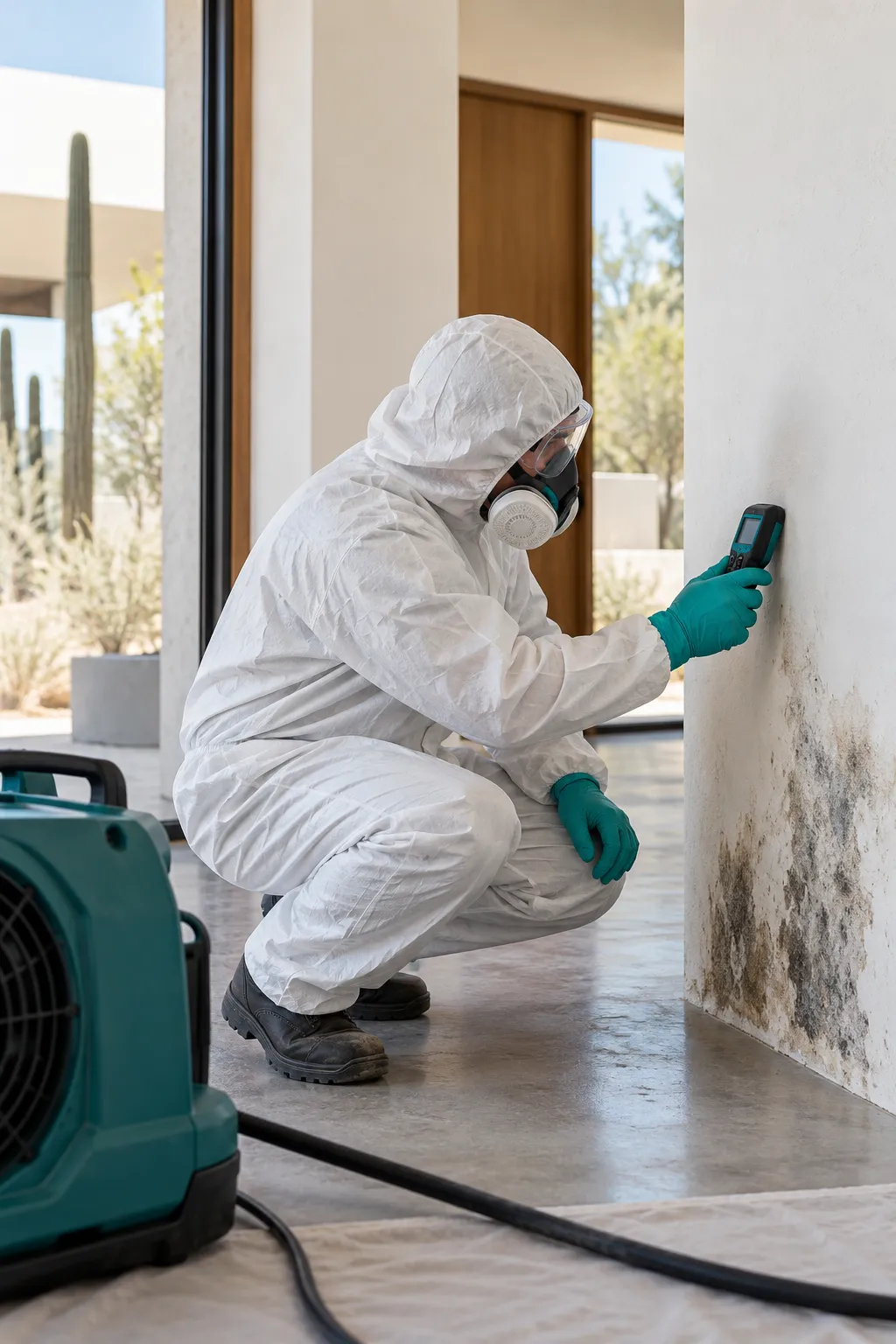
The water source. The quote should name it: which line, which penetration, which wall. If the document cannot say where the water came from, the job is not ready to be priced, because everything downstream of the source depends on it. A quote that skips this line is pricing a mystery.
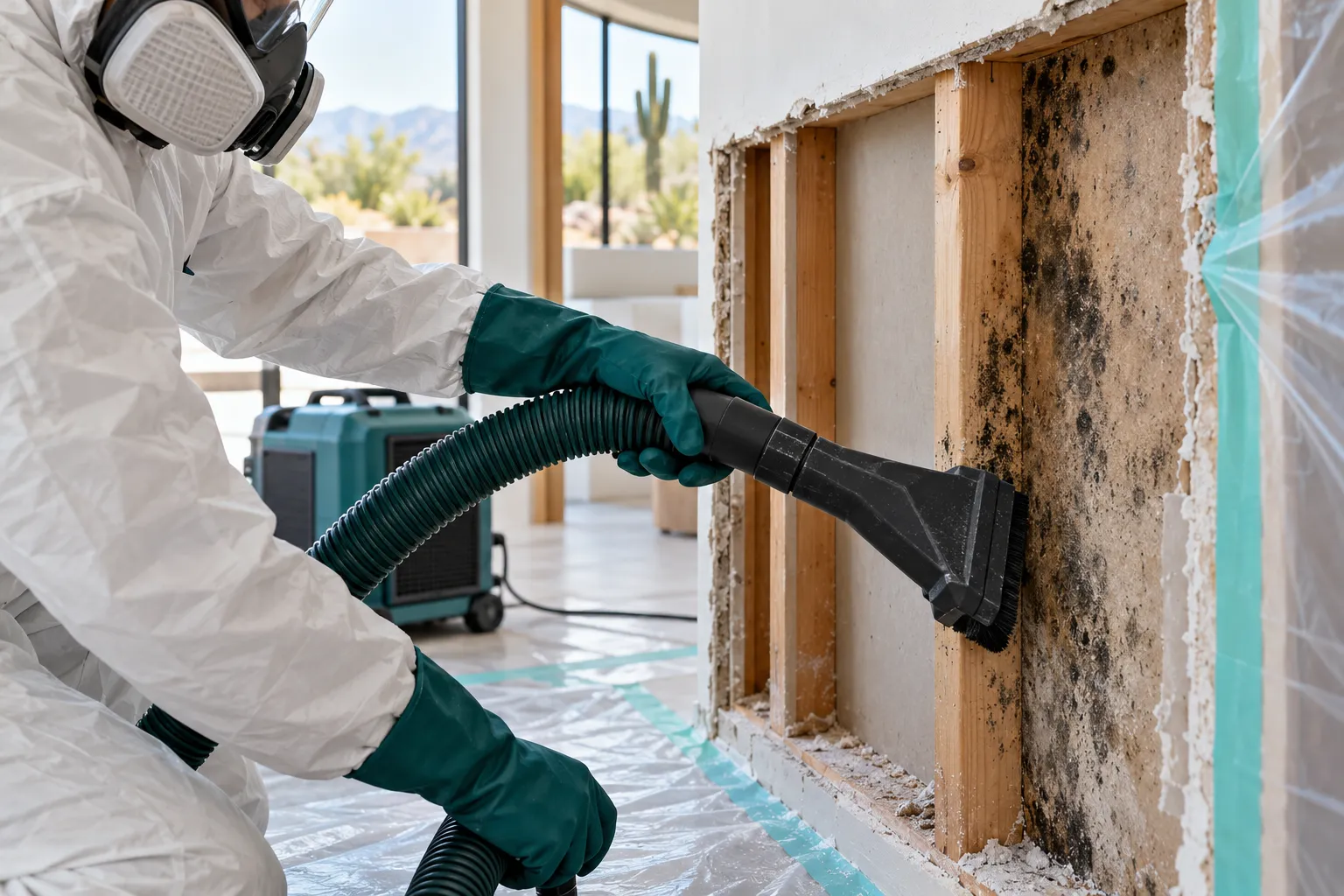
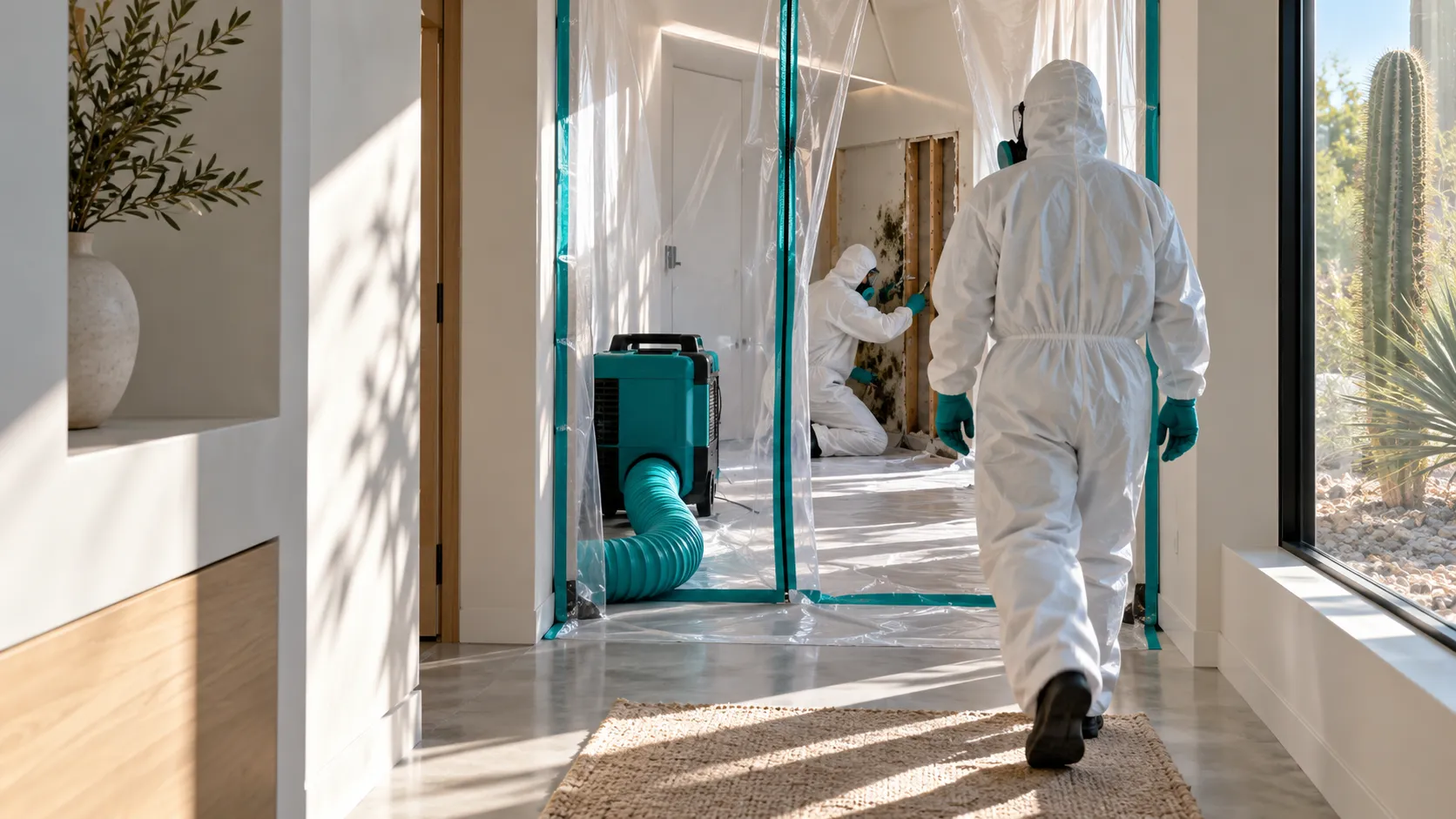
Containment. The line should say what gets sealed and how. Containment is what keeps demolition from spreading spores through the rest of the house, and in a Scottsdale home that sat closed all summer, the rest of the house is full of settled air you do not want stirred up. If there is no containment line, ask why.
Removal. How much material comes out, and from where. The rule is visible growth plus a margin into clean material, plus anything the moisture meter says is still wet. A quote that says clean and treat without saying what comes out is describing a wipe.
Drying. The cavity gets dried to a measured standard, with a meter on the wood, not a schedule on a calendar. Equipment pulled early is how the new growth appears in week three.
Clearance. Air sampling after the work, indoor counts compared against the outside. This is how the job gets signed off. A quote without a clearance line has no finish line.
Then the rebuild, which is usually priced separately, because it is a different trade. Drywall, tape, paint. If it is bundled in, it should say so, so you can see which part of the number is remediation and which part is paint. The remediation vs replacing drywall page explains where the boundary sits.
§ 03 / 06
The red flags
Some quotes announce themselves as theater, and you can usually see it in one pass.
No water source named. This is the big one. A quote that prices the mold without naming the water is pricing the symptom, and the symptom comes back.
A test sold as the solution. Air sampling has a place, and that place is the end of the job. A quote that leads with testing and follows with nothing structural is selling you a report, not a fix. A test result is not a remediation.
Containment missing or vague. If the plan is to remove moldy drywall without sealing the area, the demolition will spread spores through the house. The containment line is where you catch that.
Drying described by time instead of measurement. Dry in three days is a guess. Dry when the meter reads the right number is a standard. The quote should read like the second one.
Vague totals. Treatment, mitigation, restoration of affected areas. Words like these are not line items. Line items are square footage, rooms, and tasks. If you cannot tell what a line means, it does not mean anything.
§ 04 / 06
Questions to ask before you sign
Three questions resolve most quote confusion. Where is the water coming from, and is it stopped? Is containment included, and what does it cover? Is there a clearance test at the end, and who runs it?
Then the money questions. Who bills whom. If a claim is involved, the quote should make clear who handles the paperwork and who gets paid from where, before the work starts, not after. The insurance dance is real: a company that promises to handle the claim and does not, or bills the homeowner instead of the carrier. Ask it in writing.
And the schedule. A small cut-and-patch is days. A containment job with drying runs longer. The quote should say how long, not hint. If the timeline is missing, the scope is probably soft too.
The mold inspection and testing page covers the step that should come before any of this: the walkthrough that names the source, so the quotes you compare are both quoting the same problem.
Line open now
Mold growing right now?
Describe what you see or smell. You do not need to diagnose anything yourself.
§ 05 / 06
What good work looks like in Scottsdale
- Quotes get read side by side. Two documents for the same ceiling show which one left out the containment or the clearance.
- The source comes first. A quote without a named water source is not ready.
- Line items stay honest. You should be able to see exactly what you are paying for, in order, before anyone cuts anything.
- The full scope gets written the first time, so the cheap quote does not quietly become the expensive one.
§ 06 / 066 questions
How Do I Read a Mold Remediation Quote: your questions
01Why are two mold quotes so different?
Because they are pricing different jobs under the same name. One prices the full sequence, source to clearance. The other prices a wipe and paint. Compare line items, not totals.
02What should a remediation quote include?
The named water source, containment, material removal, drying to a measured standard, and a clearance test. Rebuild is usually priced separately, as a different trade.
03Is a cheaper quote ever the right choice?
Yes, when the scope is genuinely smaller. A small clean patch with the source fixed does not need containment. The question is whether the quote explains why its scope is smaller, or just totals lower.
04Should testing be in the quote?
Clearance testing belongs at the end of the job, and that is where a good quote puts it. A quote that leads with testing and offers nothing structural is selling a report.
05Who pays if I file an insurance claim?
It depends on the policy and what caused the water. The quote should make clear who bills whom before the work starts, so nobody is surprised by the invoice.
06How do I compare two quotes fairly?
Put them side by side and look for the missing lines: source, containment, drying, clearance. The quote that cannot name the water source is not the cheaper job. It is a different, smaller job with a bigger sequel.